

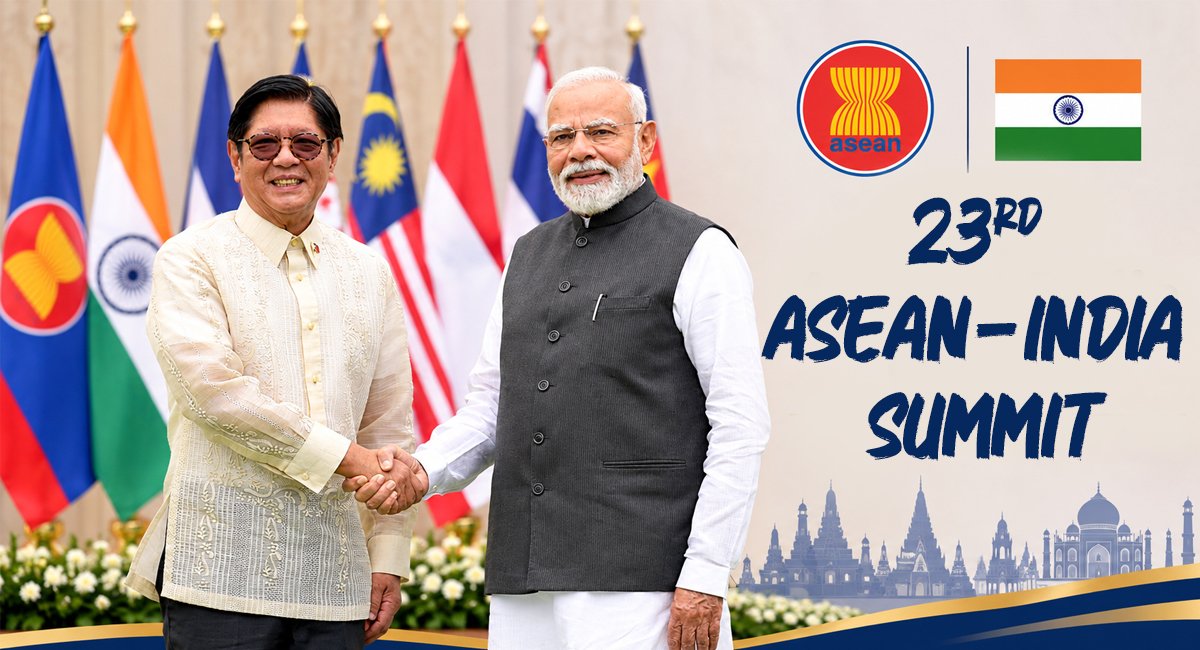
Prime Minister Narendra Modi will visit Manila, the
Philippines, from November 16–17, 2026, at the invitation of Philippine
President Ferdinand R. Marcos Jr. During the visit, he will participate in the
23rd ASEAN-India Summit and the 21st East Asia Summit, scheduled for November
17.
The meetings come at an important time for India's
engagement with Southeast Asia. Trade routes, maritime security and
supply-chain connections are becoming increasingly important to the region's
economic future.
But there is another way to understand the significance of
this visit. India's Southeast Asia strategy is not only about building stronger
diplomatic relationships. It is also about improving the country's access to
two different geographical spaces: mainland Southeast Asia through its
Northeast, and the wider Indo-Pacific through maritime partnerships.
These can be viewed as India's two gateways. They are not
parts of one physical corridor, but they serve complementary purposes in
India's broader regional ambitions.
For readers following India's wider diplomatic engagement,
Khabri Chachi has also covered PM Modi's
proposed Canada visit and its trade, energy and technology agenda and India's
agreements with Switzerland.
Why Manila Matters Beyond the Summit Meetings
The Philippines is hosting the regional meetings as ASEAN
Chair for 2026. Modi's participation will give India an opportunity to review
its Comprehensive Strategic Partnership with ASEAN and discuss the next phase
of cooperation.
The ASEAN-India Plan of Action for 2026–2030 provides the
framework for this work. It covers areas including political engagement,
economic cooperation, connectivity and maritime security.
There is also a symbolic reason for the timing. India and
ASEAN have designated 2026 as the ASEAN-India Year of Maritime Cooperation. The
two sides will mark 35 years of dialogue relations and five years of their
Comprehensive Strategic Partnership in 2027.
For India, the Philippines is more than the host of an
important summit. The visit also offers an opportunity to strengthen bilateral
engagement in defence, trade, technology and maritime cooperation.
The official Prime
Minister's Office announcement outlines the summit agenda and the wider
importance of India-ASEAN relations.
Gateway One: The Northeast's Route Towards Southeast Asia
India's Northeast is geographically positioned to connect
the country with Myanmar and, beyond it, mainland Southeast Asia.
This is where two major infrastructure projects become
important.
The India-Myanmar-Thailand Trilateral Highway is
planned to connect Moreh in Manipur with Mae Sot in Thailand through Myanmar.
If the route becomes fully functional, it could offer businesses in India's
Northeast improved road access to markets in the region.
The Kaladan Multi-Modal Transit Transport Project follows
a different route. It is designed to connect India's eastern coastline with
Mizoram through Myanmar's Sittwe Port and inland waterways.
However, these projects should not be described as finished
transport links. The waterway component of Kaladan was completed and
inaugurated in May 2023, while its 109-km road section from Paletwa in Myanmar
to Zorinpui in Mizoram remains part of the work still to be completed.
Security conditions in Myanmar, construction delays and the
reliability of cross-border movement remain major challenges. The economic
benefits will depend on whether these routes can operate consistently, not
simply on whether infrastructure has been announced or built in parts.
For India's Northeast, the opportunity is significant:
better access to regional trade could help local businesses connect with
markets beyond India's domestic borders.
The Ministry
of Development of the North Eastern Region's update on connectivity projects
provides further details about these infrastructure initiatives.
Gateway Two: The Philippines and India's Maritime Reach
The Philippines represents a different kind of gateway. It
is an archipelagic country in the western Pacific, with a strategic position in
the wider Indo-Pacific maritime region.
For India, closer engagement with Manila can strengthen
cooperation in areas such as naval interaction, maritime awareness, coastal
security and regional stability.
The relationship has an economic side as well. At the 14th
India-Philippines Joint Working Group on Trade and Investment meeting in Manila
on June 5, 2026, both sides explored opportunities in infrastructure, digital
technologies and pharmaceuticals.
Bilateral trade reached $3.9 billion in FY 2025–26,
giving the relationship a commercial foundation alongside its strategic
importance.
The Commerce
Ministry's report on the India-Philippines trade meeting gives details of
the sectors discussed and the opportunities both countries are exploring.
The Missing Link: Making Trade Easier
Better geographical access alone will not make India a
stronger trading partner in Southeast Asia. Businesses also need predictable
rules, competitive logistics and smoother movement of goods.
This is why the ASEAN-India Trade in Goods Agreement, or
AITIGA, deserves attention.
India and ASEAN are reviewing the agreement to address
trade-related concerns and make the framework more effective. The latest round,
the 15th AITIGA Joint Committee meeting, took place in Jakarta from October 6
to 9, 2026.
Both sides asked the relevant sub-committees to speed up
work on outstanding chapters and establish time-bound targets. The next Joint
Committee meeting is scheduled for January 2027 in India.
The review is still underway, so it would be premature to
assume that businesses will immediately benefit from a revised agreement. Its
eventual value will depend on whether the two sides can resolve outstanding
issues and create more balanced trading conditions.
For Indian exporters, this matters as much as
infrastructure. A road or port can improve access, but trade rules determine
how efficiently companies can use that access.
The October
2026 AITIGA meeting update from the Commerce Ministry explains the progress
made during the latest round of negotiations.
Why Maritime Cooperation Has Become a Priority
International trade depends heavily on shipping. Disruptions
at sea can affect energy supplies, industrial materials and the delivery of
everyday goods.
India's maritime engagement with ASEAN therefore has an
economic purpose as well as a security dimension.
Cooperation can include information sharing, maritime domain
awareness, search and rescue, naval exchanges and efforts to address challenges
such as piracy and illegal fishing.
The Philippines is a relevant partner in this effort because
of its location and growing engagement with India. Its role as ASEAN Chair in
2026 also gives it an important position in regional discussions.
The ASEAN-India Year of Maritime Cooperation provides an
opportunity to turn broad commitments into practical activities.
Three Outcomes to Watch in Manila
The importance of Modi's visit will ultimately depend on
what follows the meetings. Three areas deserve particular attention.
1. A clearer trade roadmap: The AITIGA review needs
measurable progress. The Manila discussions could help maintain political
momentum, while the next formal committee meeting in January 2027 will be an
important point to watch.
2. More reliable connectivity: India needs its
Northeast-facing projects to become usable trade routes. Progress on the
unfinished sections of the Kaladan project and the Trilateral Highway will
matter more than fresh announcements.
3. Practical maritime cooperation: India and ASEAN
need to build on existing naval exchanges and maritime dialogue. More
coordination, information sharing and operational engagement could strengthen
regional confidence.
India's wider engagement with international groupings is
also relevant here. Its participation in platforms such as BRICS and its
diplomatic outreach to major economies show how trade, security and technology
are increasingly connected in its foreign policy.
India's Two Gateways Must Work Together
The two-gateway idea highlights an important distinction in
India's Southeast Asia strategy. The Northeast offers a possible land
connection towards mainland Southeast Asia, while the Philippines strengthens
India's engagement with the maritime Indo-Pacific.
Neither route can deliver results on its own. Land
connectivity depends on infrastructure and stability in Myanmar. Maritime
cooperation needs regular engagement, trust and practical coordination. Trade
agreements must also make it easier for businesses to move products across
borders.
That is what makes the Manila meetings worth watching. Their
real significance will not be measured only by summit statements, but by
whether India can turn its geographical advantages and diplomatic relationships
into dependable economic and strategic connections.



Discussion & Comments (0)
No comments yet. Be the first to share your thoughts on this story!
Leave a Comment