

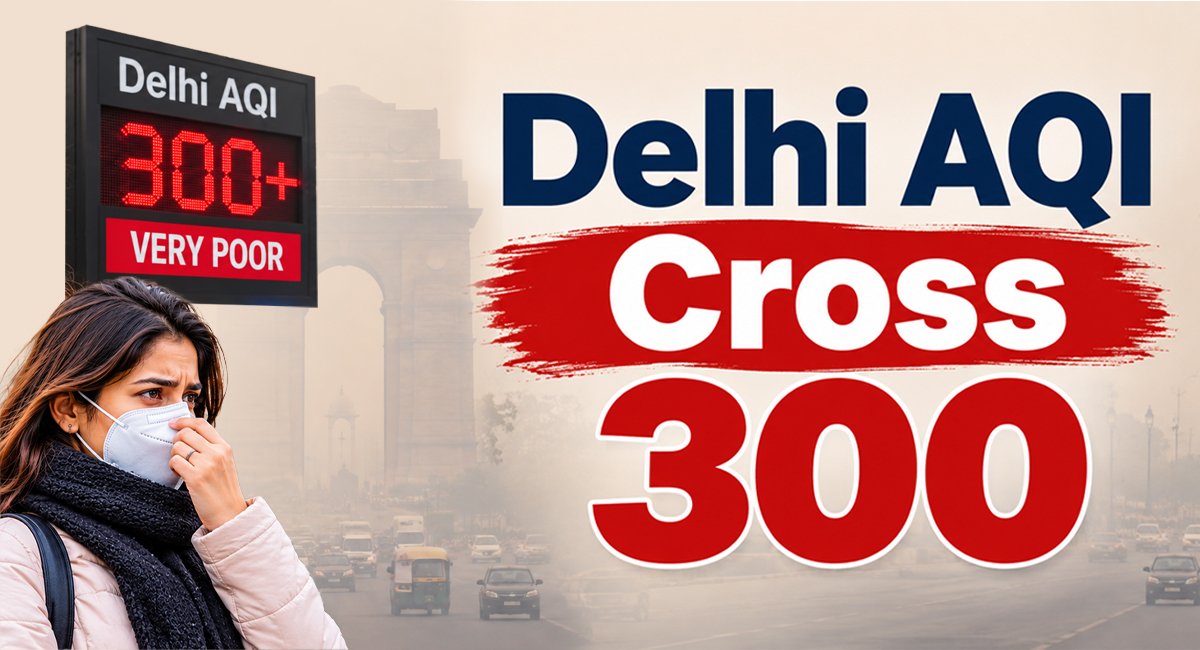
Delhi's air pollution continues to raise concerns after
Diwali, with several parts of the national capital recording severe air quality
levels on November 9, 2026. Thick smog and reduced visibility have added to the
concerns of residents, particularly those who travel outdoors for work, school
or daily activities.
According to the Commission for Air Quality Management
(CAQM), Delhi's AQI stood at 372 at 1 AM on November 9, placing the city
in the 'Very Poor' category. However, individual monitoring stations reported
much higher readings. Burari Crossing recorded an AQI of 441, while Vivek Vihar
reached 437 and Delhi Technological University recorded 434, according to a report
citing CPCB data.
These readings highlight an important point: Delhi's
average AQI does not tell the complete story of the air people are breathing in
every neighbourhood.
Delhi AQI on November 9: Some Areas Record Severe
Pollution
The difference between the citywide reading and individual
monitoring stations is significant.
The reported readings from some locations on Monday morning
were:
- Burari
Crossing: 441
- Vivek
Vihar: 437
- Delhi
Technological University: 434
- North
Campus: 433
- Jahangirpuri:
433
An AQI above 400 falls under the 'Severe' category. This
means residents in areas recording such levels may be facing worse air quality
than the citywide average suggests.
Air quality can vary from one monitoring station to another
because pollution sources, traffic movement and local weather conditions are
not the same across the city. Residents should therefore check the nearest
available monitoring station instead of depending only on Delhi's overall AQI.
What Does an AQI of 372 Actually Mean?
The Air Quality Index (AQI) is used to communicate the level
of air pollution through a numerical scale. India's official AQI classification
divides air quality into six categories:
|
AQI Range |
Air Quality |
|
0–50 |
Good |
|
51–100 |
Satisfactory |
|
101–200 |
Moderate |
|
201–300 |
Poor |
|
301–400 |
Very Poor |
|
401–500 |
Severe |
A reading of 372 falls in the Very Poor category, while
readings above 400 are classified as Severe.
Delhi's monitoring data has also identified PM2.5 as a
prominent pollutant at several stations. PM2.5 refers to extremely small
particles that can enter deep into the lungs. This is one reason why high
pollution levels deserve attention even when the air does not look particularly
smoky.
Why Is Delhi's Air Quality Deteriorating?
Delhi's pollution problem does not have a single cause.
Several sources contribute to the city's air quality challenges.
Vehicle emissions, construction dust, road dust and
industrial activities add pollutants to the air. Firecracker emissions around
Diwali can further increase particulate pollution.
Crop-residue burning in parts of Punjab and Haryana is
another seasonal concern. Weather conditions also influence how quickly
pollutants disperse. When the atmosphere does not allow pollution to spread
effectively, pollutants can remain concentrated near the ground.
This combination makes the post-Diwali period particularly
challenging for Delhi and neighbouring areas.
GRAP Stage III Restrictions Remain in Force
The Commission for Air Quality Management invoked Stage III
of the Graded Response Action Plan (GRAP) across Delhi-NCR on November 6, 2026.
The decision followed a review of pollution levels and
weather forecasts. At the time, Delhi's daily average AQI was 382, and
forecasts indicated that air quality could deteriorate further.
Stage III adds stricter measures to the restrictions already
in place under the earlier stages. These include curbs on certain construction
and demolition activities and restrictions on specified older vehicles in Delhi
and designated NCR areas. Some exemptions and conditions apply, so residents
should check the official orders before making assumptions about individual
vehicles or activities.
The government has also advised people to reduce unnecessary
travel, choose cleaner transport options and follow instructions regarding
hybrid schooling or work-from-home arrangements where applicable.
Residents can check the latest announcements on the official CAQM website.
How Can Residents Reduce Exposure to Air Pollution?
Pollution cannot be avoided completely in a city
experiencing very poor air quality, but a few precautions can help reduce
exposure.
- Check
the latest AQI for your locality before planning outdoor activities.
- Avoid
strenuous outdoor exercise when pollution levels are very high.
- Consider
a well-fitting N95 mask when outdoor exposure is unavoidable.
- Keep
children, older adults and people with existing respiratory or heart
conditions away from heavily polluted outdoor environments as far as
possible.
- Follow
health advice and seek medical help if you experience breathing
difficulty, chest discomfort or other concerning symptoms.
For live readings, residents can visit the Delhi government's air quality dashboard.
The CPCB AQI
information document also explains India's air quality categories.
Delhi's AQI Is More Than a Citywide Number
A single AQI figure can make pollution look like a citywide
problem with one common level. In reality, readings can differ considerably
between neighbourhoods and monitoring stations.
For residents, the more useful question is not only whether
Delhi's AQI is 372 or 400, but also what the nearest monitoring station is
reporting and how long they may need to remain outdoors.
With GRAP Stage III measures in force and several monitoring
stations reporting severe pollution, Delhi's air quality remains a concern on
November 9. Regularly checking local readings and following official advisories
can help residents make more informed decisions during the pollution season.



Discussion & Comments (0)
No comments yet. Be the first to share your thoughts on this story!
Leave a Comment