

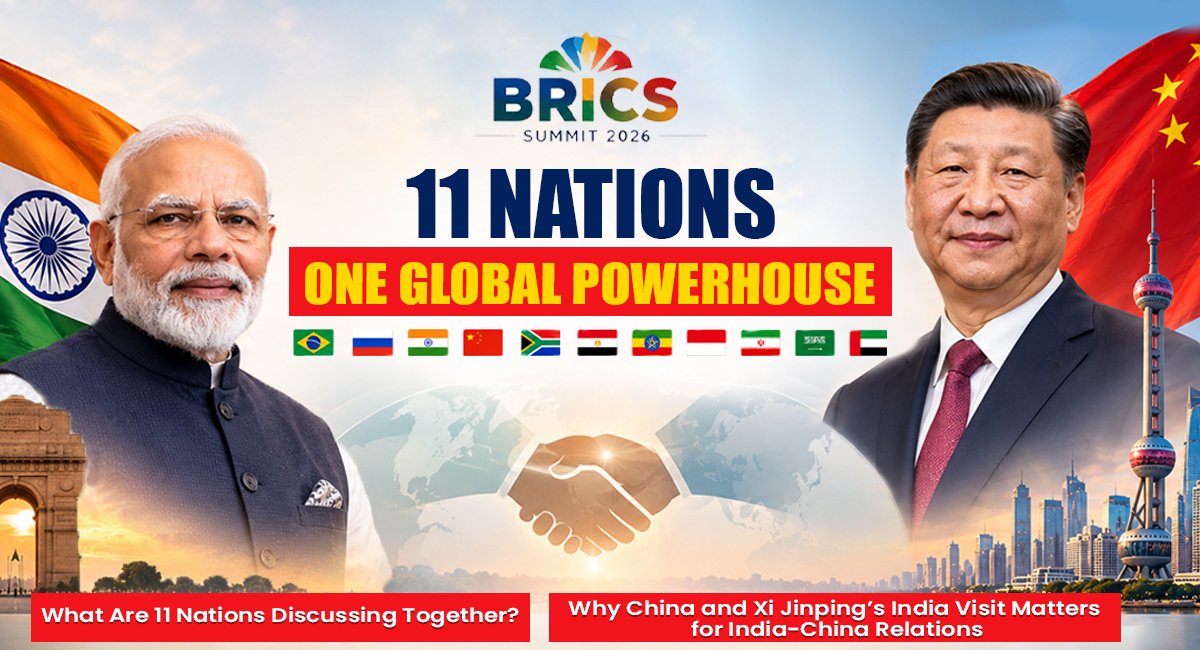
What Is BRICS and Why Has It Become So
Important?
BRICS originally brought together Brazil, Russia, India
and China, with South Africa joining later. The grouping has
since expanded considerably. Egypt, Ethiopia, Iran, the UAE and Saudi Arabia
joined in 2024, while Indonesia became a member in 2025, taking the number of
full members to 11. The expanded BRICS represents a huge share of the world's
population and economy, giving the grouping increasing importance in
discussions about global governance, finance, trade, energy and development.
India and China can disagree sharply on their border while cooperating through
BRICS. India can maintain close defence and energy relations with Russia while
simultaneously developing a strategic partnership with the United States. Saudi
Arabia and Iran can sit within the same grouping despite their
BRICS Summit 2026: Why India-China relations Are Under the Global Spotlight
The 18th BRICS Summit is taking place in New Delhi on September 12–13, 2026.But among all the diplomatic conversations taking place in New Delhi, one relationship is attracting particularly close attention: India and China. Chinese President Xi Jinping has arrived in India for the summit, his first visit to the country in seven years, and is scheduled to meet Prime Minister Narendra Modi. The meeting comes after years of military tensions, diplomatic mistrust and economic disagreements between the two Asian powers. However, the significance of BRICS 2026 goes much beyond the Modi-Xi meeting. The summit is also about India's relationship with Russia, China's growing influence, the Pakistan factor, US-China competition, energy security, global trade, the Global South and the future of the international order.
From Border Conflict to
Cautious Thaw
The relationship has changed again over the past two years. In October 2024, India and China reached a disengagement arrangement concerning military positions along the disputed border. The withdrawal process from remaining confrontation points was completed by December 2024. Since then, both countries have gradually attempted to stabilise relations. Direct flights have resumed; visa procedures have been eased and some restrictions affecting business and Chinese equipment have been relaxed. In August 2026, the two countries also held the 25th round of Special Representatives' talks on the boundary question. The two sides agreed on additional military communication channels, more border-management meetings and continued discussions concerning trans-border rivers. They also agreed to hold the next Special Representatives' meeting in India in 2027. This shows that the relationship has moved away from the intense confrontation of 2020.But that does not mean the dispute has disappeared.
Trade: Cooperation and Dependence at the Same
Time
India-China economic relations present another major contradiction.
Political relations deteriorated after 2020, but economic dependence did not disappear.
In fact, China remained India's largest source of imports in the 2025–26
financial year, with imports worth around $132 billion, according to
Reuters. These included products and components considered important for Indian
manufacturing. India imports a wide range of products from China, including:
- Electronics
- Machinery
- Industrial components
- Chemicals
- Pharmaceutical inputs
- Solar equipment
- Telecommunications equipment
This creates a strategic dilemma. India wants to reduce excessive dependence on China in sensitive sectors, but completely separating the two economies would be extremely difficult. Therefore, New Delhi's approach is increasingly about diversification rather than complete decoupling.
BRICS and the Changing Global Order
The expanded grouping represents a large share of global population and
economic activity and increasingly seeks a stronger voice for emerging
economies in international institutions.
BRICS members have discussed:
- Reform
of global institutions
- Greater
representation for developing countries
- Trade
cooperation
- Local-currency
settlements
- Cross-border
payments
- Energy
security
- Food
security
- Technology
- Critical
supply chains
However, BRICS does not have a single foreign-policy position. Some members
favour a stronger challenge to Western dominance, while others — including
India — are more cautious about turning BRICS into an explicitly anti-Western
organisation.
Why the Other BRICS Countries Matter
A proper understanding of BRICS 2026 also requires looking beyond the
India-China relationship.
Brazil
Brazil gives BRICS a major Latin American presence and brings agricultural,
food-security and commodity interests into the grouping.
South Africa
South Africa remains an important bridge to the African continent and
strengthens BRICS' Global South identity.
Egypt
Egypt's location gives it importance for trade routes, the Middle East and
Africa.
Ethiopia
Ethiopia strengthens BRICS' representation in Africa and brings development
and food-security priorities.
Iran
Iran adds major energy and geopolitical significance, especially amid
continuing tensions in West Asia.
Indonesia
Indonesia gives BRICS a major Southeast Asian economy and strengthens its
connection with the wider Indo-Pacific.
Saudi Arabia
Saudi Arabia is strategically important because of its energy resources,
investment capacity and influence in the Middle East.
UAE
The UAE contributes financial, logistics, energy and investment strength.
Final Takeaway
BRICS Summit 2026 is
not simply an India-China story. The India-China relationship
is certainly one of the most important issues surrounding the summit,
particularly because Xi Jinping's visit comes after years of border tensions
and diplomatic mistrust. But the larger picture is much bigger. The summit
brings together 11 countries with different political
systems, economic interests and foreign-policy priorities at a
time when the global order is changing rapidly. India’s challenge is to
cooperate with China without compromising its security interests, maintain its
relationship with Russia without becoming dependent on Moscow, strengthen ties
with the US without abandoning strategic autonomy, and simultaneously build stronger
partnerships across the Global South.
Sources
Reuters, PIB & other media reports. Some information is based on ongoing reports and may not be fully confirmed.



Discussion & Comments (0)
No comments yet. Be the first to share your thoughts on this story!
Leave a Comment