

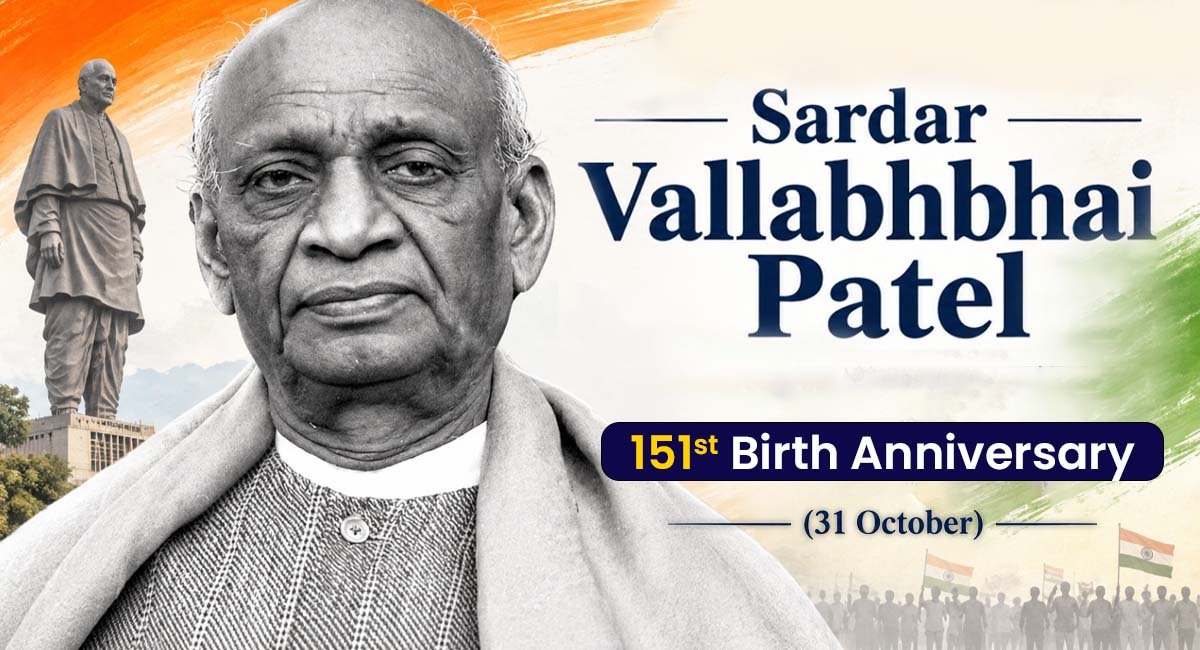
India celebrates Sardar Vallabhbhai Patel Jayanti every year
on October 31. This day marks the birth anniversary of one of the most
important leaders in Indian history. Popularly known as the Iron Man of India,
Sardar Vallabhbhai Patel played a major role in bringing different parts of the
country together after independence.
Born on October 31, 1875, Patel was India's first Deputy
Prime Minister and Home Minister. His contribution to the freedom movement and
the political unity of India is still remembered today. You can read more about
his life and achievements on the Ministry of Culture's
official website.
In 2026, the country is celebrating his 151st birth
anniversary. The day is also observed as National Unity Day, or Rashtriya
Ekta Diwas, to spread the message of unity, peace and national integrity.
Who Was Sardar Vallabhbhai Patel?
Sardar Vallabhbhai Patel was an Indian freedom fighter,
lawyer and political leader. He was born in Nadiad, Gujarat, into a farming
family. Before joining the freedom movement, he worked as a successful lawyer.
His life changed after he came in contact with Mahatma
Gandhi. Inspired by Gandhi's ideas, Patel became involved in India's struggle
against British rule.
He became popular for his leadership during the Kheda
Satyagraha in 1918 and the Bardoli Satyagraha in 1928. During these movements,
he supported farmers who were protesting against unfair taxes and British
policies.
His leadership during the Bardoli movement earned him the
title of Sardar, which means leader or chief. More details about these
movements are available in the Ministry of Culture's
biography of Sardar Patel.
Why Is Sardar Vallabhbhai Patel Called the Iron Man of
India?
Sardar Vallabhbhai Patel is known as the Iron Man of India
because of his strong leadership, determination and important role in bringing
the country together.
After India gained independence in 1947, the country faced a
major challenge. Hundreds of princely states had to decide their future and
become part of the newly independent nation.
Patel took responsibility for this difficult task. Through
discussions, negotiations and diplomatic efforts, he helped bring more than 560
princely states into the Indian Union. The Government
of India's account of Patel's role in India's political integration
provides more information about his efforts.
His efforts played an important role in building a united
India. This is one of the main reasons why he is remembered as the Iron Man of
India.
Sardar Vallabhbhai Patel's Role After India's
Independence
After independence, Sardar Vallabhbhai Patel became India's
first Deputy Prime Minister and Home Minister.
He worked to bring political stability to the newly
independent country. His major responsibilities included the integration of
princely states, maintaining internal security and building a strong
administrative system.
He also supported the development of All India Services,
including the Indian Administrative Service (IAS) and Indian Police Service
(IPS).
His work helped create a strong foundation for India's
administration. You can read more about his contribution in this official
government document on Sardar Patel.
What Is National Unity Day and Why Is It Celebrated on
October 31?
National Unity Day is also known as Rashtriya Ekta Diwas. It
is celebrated every year on October 31 to mark the birth anniversary of Sardar
Vallabhbhai Patel.
The Government of India started observing this day in 2014
to remember his contribution to national integration. The decision was
announced by the Ministry
of Home Affairs through an official Press Information Bureau release.
The main purpose of National Unity Day is to remind people
that India's strength comes from unity despite differences in language,
religion, culture and traditions.
On this day, people are encouraged to work together and
respect the country's diversity.
How Is National Unity Day Celebrated in India?
National Unity Day is observed across the country through
different events and activities.
Some common activities include:
1. Run for Unity
People take part in the Run for Unity to spread the message
of national unity and togetherness. Schools, colleges and local organisations
also organise running events.
2. Unity Pledge
Government offices, schools and other institutions organise
unity pledge ceremonies. Participants promise to protect the country's unity,
integrity and security.
3. School and College Activities
Students take part in essay writing, drawing competitions,
speeches, debates and cultural programmes based on national unity.
4. Unity Parade
Police forces and other security personnel participate in
parades to mark the occasion. These events highlight teamwork, discipline and
national pride.
5. Cultural Programmes
Different cultural performances showcase India's traditions
and diversity. These programmes remind people that different cultures are an
important part of one nation.
The Ministry
of Home Affairs' official announcement about National Unity Day activities
also mentions events such as the Run for Unity, pledge ceremonies and police
marches.
Statue of Unity: A Tribute to Sardar Vallabhbhai Patel
The Statue of Unity is one of the most famous landmarks
dedicated to Sardar Vallabhbhai Patel.
Located near Ekta Nagar in Gujarat, the statue was
inaugurated on October 31, 2018. Standing at 182 metres, it is recognised as
the world's tallest statue. According to Guinness
World Records, the Statue of Unity holds this record.
The monument represents Patel's contribution to bringing
India together. It has also become an important tourist destination where
visitors can learn about his life and achievements.
Every year, special events are organised around the Statue
of Unity to mark his birth anniversary and National Unity Day.
Why Is Sardar Patel's Contribution Still Important Today?
Sardar Vallabhbhai Patel's contribution remains important
because he helped build a united country during one of the most difficult
periods in Indian history.
His leadership showed how discussions, determination and
cooperation can help solve major challenges.
National Unity Day gives people an opportunity to remember
his work and understand the importance of staying united.
His life also reminds young people that the development of a
country depends on the contribution and cooperation of its citizens.
Conclusion
Sardar Vallabhbhai Patel Jayanti is more than a birth
anniversary. It is a day to remember the leader who played a major role in
shaping modern India.
On his 151st birth anniversary in 2026, National Unity Day
reminds every Indian of the importance of unity, peace and national integrity.
His contribution to the country will always remain an
important part of India's history.

Discussion & Comments (0)
No comments yet. Be the first to share your thoughts on this story!
Leave a Comment