

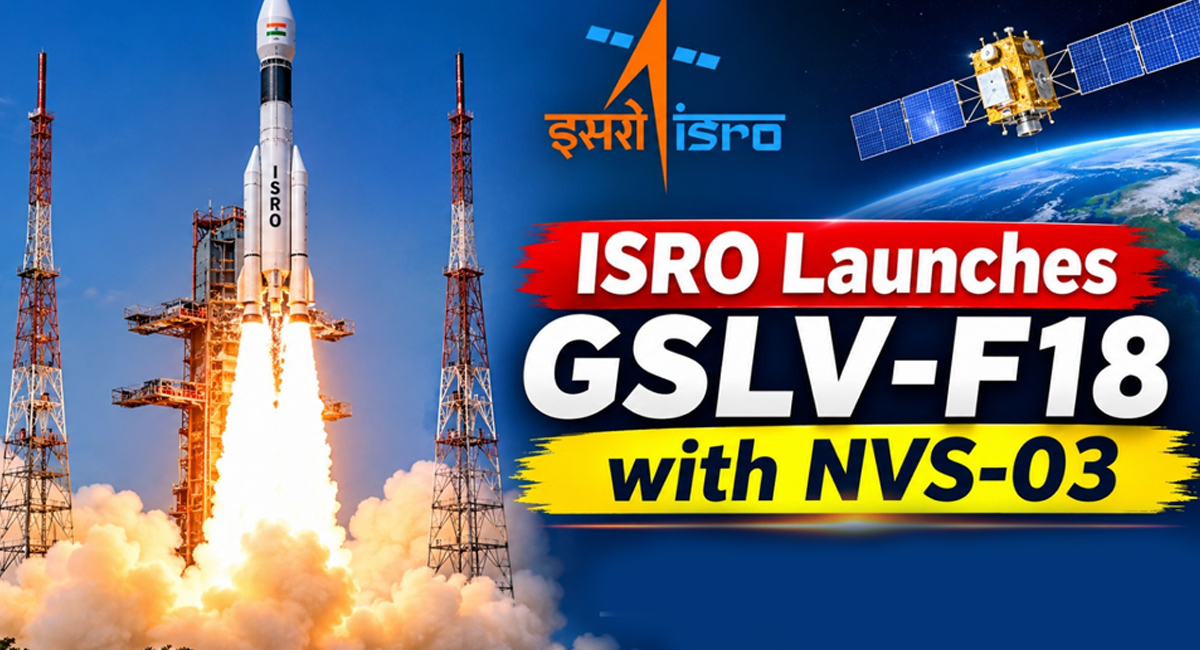
India has taken another step forward in space technology. ISRO has successfully launched its GSLV-F18 rocket carrying the NVS-03 navigation satellite.
The rocket lifted off on October 30, 2026, from Sriharikota
in Andhra Pradesh. The satellite was placed into its planned transfer orbit
after the launch.
This mission is important because NVS-03 will help improve
India's own navigation system, called NavIC. The system helps people and businesses
find locations and get accurate timing information.
When and Where Was GSLV-F18 Launched?
ISRO launched GSLV-F18 at 11:51 PM IST on October 30, 2026.
The launch took place from the Second Launch Pad at the Satish Dhawan Space
Centre in Sriharikota.
GSLV-F18 is the 20th flight of India's Geosynchronous
Satellite Launch Vehicle (GSLV).
The rocket carried a 2,250-kg satellite named NVS-03. ISRO
confirmed that the satellite reached its planned Geosynchronous Transfer Orbit
(GTO).
You can read the mission details on the official ISRO website.
What Is the NVS-03 Satellite?
NVS-03 is part of ISRO's second-generation navigation
satellite series. It has been developed to support India's NavIC system.
The satellite carries an Indian-made atomic clock. It also
supports the L1 navigation signal, along with the L5 and S-band signals.
These features will help improve navigation services and
allow more devices to use NavIC.
What Is NavIC?
NavIC stands for Navigation with Indian Constellation. It is
India's own satellite navigation system, developed by ISRO.
You can think of it as India's alternative to GPS. It helps
users find their location and get navigation information.
NavIC covers India and an area extending around 1,500
kilometres beyond the country's borders.
It can be useful in many areas, such as:
- Road
travel: Helps with location and route information.
- Fishing:
Supports fishermen with navigation and location details.
- Transport:
Helps track vehicles and manage deliveries.
- Emergency
services: Can support location-based services.
- Timing:
Provides accurate time information for important systems.
How Will NVS-03 Help India?
NVS-03 will add new features to India's navigation system.
One important addition is support for the L1 signal. Many
smartphones and navigation devices use this signal, so it can help make NavIC
useful for more consumer devices.
The satellite also carries an Indian-made atomic clock. This
clock helps provide accurate time information, which is important for finding
the correct location.
With NVS-03, ISRO aims to improve the availability and
performance of NavIC services.
What Happens After the Launch?
Reaching the transfer orbit is not the final step of the
mission.
ISRO will carry out further operations to move the satellite
towards its planned position. These steps are known as orbit-raising
manoeuvres.
After reaching its required position, the satellite will go through
checks before starting its regular navigation work.
Why Is This Mission Important?
India uses satellite navigation for many daily activities,
including road travel, transport, communication and emergency services.
A strong homegrown navigation system gives India more
control over these services. It also reduces the need to depend only on
navigation systems operated by other countries.
The GSLV-F18 mission is another step in ISRO's effort to
improve India's space technology and navigation facilities.
Conclusion
The successful launch of GSLV-F18 carrying NVS-03 is good
news for India's space programme.
The new satellite will support NavIC and help improve
India's own navigation services. Once it completes the remaining steps and
becomes operational, it will add more strength to the country's satellite
navigation network.
This mission also shows how India is continuing to build its
own technology for important services used in eve


Discussion & Comments (0)
No comments yet. Be the first to share your thoughts on this story!
Leave a Comment