

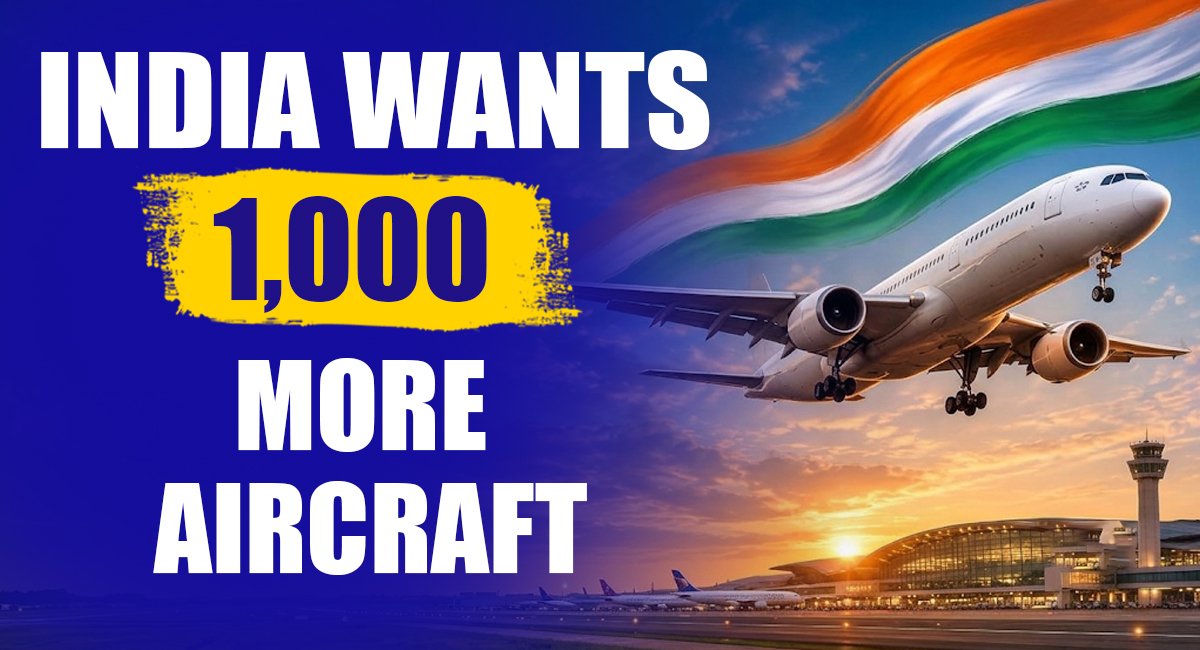
India's aviation ambitions are growing faster than the number of aircraft available to its airlines. With passenger demand creating pressure for more flights and international connections, the country is now looking beyond its existing aircraft orders.
Union Commerce and Industry Minister Piyush Goyal said on
November 16 that India is ready to order another 1,000 civilian aircraft. The
country has already placed orders for more than 1,200 planes, but its total
requirement could exceed 2,000 aircraft.
The announcement highlights an important challenge for
Indian aviation: buying more aircraft is only one part of the expansion.
Airlines will also need timely deliveries, trained employees, maintenance
facilities and supporting airport infrastructure to turn those orders into
additional flights.
The Aircraft Shortage Behind India's Aviation Ambitions
Speaking to reporters during his visit to Cairo, Goyal said
India was facing an acute shortage of civilian aircraft. He added that the
government was pursuing established manufacturers to accelerate aircraft
supplies.
Indian carriers, particularly IndiGo and Air India, have
placed substantial orders with Airbus and Boeing. However, large orders do not
translate into immediate fleet expansion. Aircraft manufacturing and delivery
schedules determine how quickly airlines can introduce new planes into service.
Goyal also linked aircraft availability with international
connectivity. He said additional planes could help airlines operate more
flights between India and Egypt. EgyptAir currently operates direct services
between the two countries.
His comments were reported by ThePrint's
PTI report and Moneycontrol.
The Bigger Challenge: Aircraft Need Pilots and Engineers
Too
The scale of India's future aviation requirements becomes
clearer when looking at industry projections.
In January 2026, Airbus estimated that India's commercial
aircraft fleet could triple to around 2,250 aircraft by 2035. The company also
projected annual passenger traffic growth of 8.9% over the period.
But fleet expansion will require a much larger workforce.
According to Airbus, India could need around 35,000 pilots and 34,000
technicians by 2035, compared with approximately 12,000 pilots and 11,000
technicians at the time of its forecast.
The maintenance sector will also have to grow. Airbus
projected that India's aircraft maintenance, repair and overhaul (MRO) market
could reach $9.5 billion by 2035.
These figures show why the next phase of aviation growth
cannot depend on aircraft purchases alone. Airlines and the wider industry will
need enough trained professionals and maintenance capacity to keep a larger
fleet operating.
Read the Airbus
India fleet outlook for its full projections.
Airports Are Expanding, but Fleet Availability Still
Matters
India has also invested in expanding its airport network and
passenger-handling capacity. According to a government statement reported by
The Economic Times in August 2026, airports across the country had the capacity
to handle more than 580 million passengers annually, while passenger traffic
during FY2025-26 was around 420 million.
That gap between airport capacity and actual traffic does
not mean every airport has spare capacity at every time of day. However, it
illustrates that airport infrastructure and airline fleet availability are
separate parts of the aviation equation.
A terminal can accommodate more passengers, but airlines
still need aircraft, crew and operational capacity to schedule additional
services. This is particularly important for routes where carriers want to
increase flight frequency or introduce new international connections.
The government's
airport-capacity update provides further context.
Airbus, Boeing and India's Manufacturing Opportunity
Airbus and Boeing will remain central to India's fleet
expansion because Indian airlines have placed major orders with both
manufacturers.
Their relationship with India also extends beyond aircraft
sales. Airbus operates two final assembly lines in the country, including
facilities for military transport aircraft and helicopters. Airbus and Boeing
together procure components and services worth around $2 billion annually from
Indian suppliers, according to reports.
India is also looking to strengthen its domestic aerospace
manufacturing base. Brazilian aircraft maker Embraer has entered into a
strategic collaboration with the Adani Group to explore regional aircraft
manufacturing opportunities in India.
These developments could support local suppliers and create
opportunities in engineering, maintenance and manufacturing. However, the
proposed manufacturing plans should not be treated as confirmed large-scale
commercial aircraft production commitments.
What the Next 1,000 Aircraft Could Mean for Passengers
If India places additional orders and manufacturers deliver
aircraft according to the required timelines, airlines could gain more
flexibility to expand domestic and international services.
Passengers could eventually benefit from more flight
options, improved connections between cities and additional international
routes. The India-Egypt connection is one example specifically mentioned by
Goyal.
But the impact will depend on when aircraft arrive, how
airlines deploy them and whether the industry can expand its workforce and
maintenance capabilities at the same pace.
For now, the minister's statement is an indication of
India's potential aircraft requirement, not confirmation of a new 1,000-plane
purchase contract. The more important question is whether the country's
aircraft suppliers and aviation ecosystem can keep pace with the expansion
Indian airlines are planning.



Discussion & Comments (0)
No comments yet. Be the first to share your thoughts on this story!
Leave a Comment