

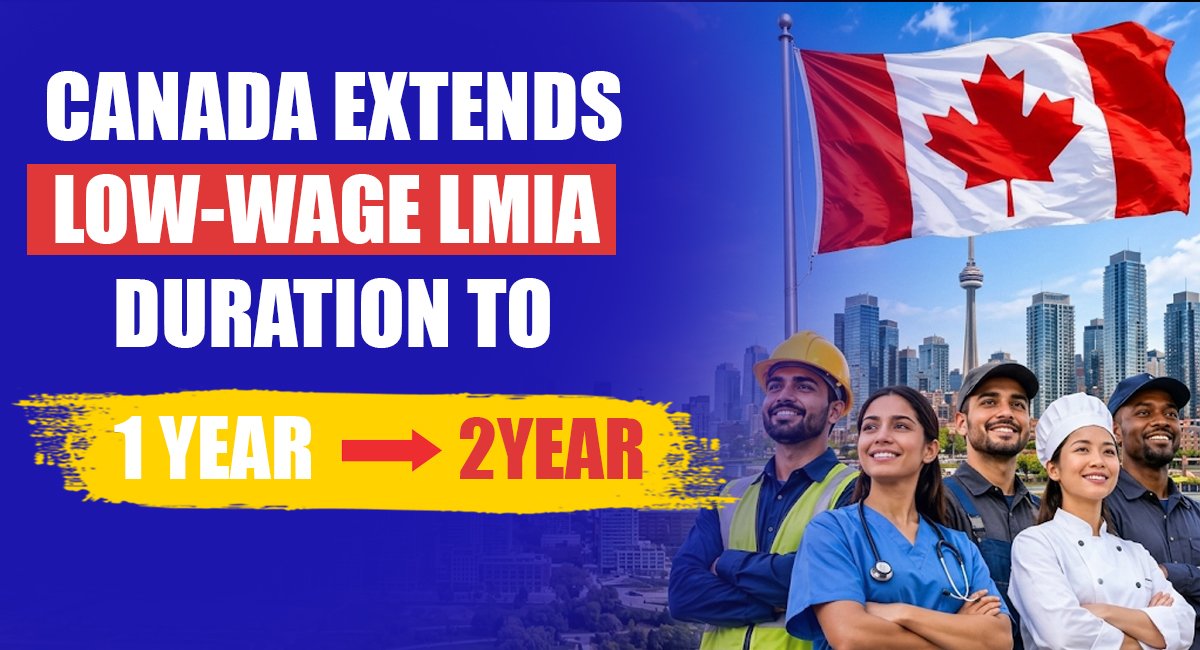
Canada has introduced important changes to its Temporary Foreign Worker Program (TFWP), giving eligible employers more flexibility when hiring foreign workers under the Low-Wage Stream. Effective November 6, 2026, the maximum duration of new Low-Wage Stream Labour Market Impact Assessments (LMIAs) has increased from one year to up to two years.
The federal government has also added early childhood
educators to the list of occupations exempt from certain low-wage LMIA
processing restrictions in areas with high unemployment.
For foreign workers planning to move to Canada, the changes
could offer more employment continuity. However, there is one important
distinction: a two-year LMIA does not automatically guarantee a two-year
work permit.
Here is what has changed, who may benefit and what
applicants should understand before making employment or immigration decisions.
Canada’s New Low-Wage LMIA Rules: What Changed on
November 6?
According to Employment and Social Development Canada
(ESDC), the new rules took effect on November 6, 2026.
The first major change increases the maximum duration of
Low-Wage Stream LMIA applications from one year to up to two years. The
extended duration applies to applications submitted on or after November 6,
2026.
Previously, employers could receive approval for a maximum
period of one year under this stream. The longer duration is intended to reduce
repeated applications and help businesses plan their staffing requirements over
a longer period.
However, two years is the maximum permitted duration, not an
automatic approval. Employers must still meet the program's requirements, and
every application remains subject to assessment.
Read the official
ESDC announcement.
Early Childhood Educators Added to LMIA Exemptions
Another important development concerns Canada's childcare
sector.
Under existing restrictions, certain Low-Wage Stream LMIA
applications are not processed when the job is located in a Census Metropolitan
Area (CMA) with an unemployment rate of 6% or higher.
Healthcare, construction and food processing are among the
priority sectors that already have exceptions to this restriction.
From November 6, 2026, early childhood educators were added
to the list.
This means eligible employers hiring early childhood
educators can submit low-wage LMIA applications in metropolitan areas affected
by the unemployment-related processing restriction.
The change could provide additional hiring flexibility to
childcare centres and employers facing difficulties recruiting qualified staff.
However, this is an exception to the processing restriction,
not a complete exemption from the LMIA process. Employers must still meet the
applicable requirements.
Does a Two-Year LMIA Mean a Two-Year Canadian Work
Permit?
This is one of the most important questions for foreign
workers.
An LMIA and a work permit are two separate parts of Canada's
temporary employment process.
A Labour Market Impact Assessment is issued through ESDC
after assessing an employer's need to hire a foreign worker. A positive LMIA
generally supports an employer-specific work permit application.
The work permit, however, is issued by Immigration, Refugees
and Citizenship Canada (IRCC).
A longer LMIA may allow an eligible worker to apply for an
employer-specific work permit covering a longer employment period. However, the
final permit duration is determined by IRCC and depends on the application,
employment details and other applicable requirements.
Therefore, a two-year LMIA should not be treated as an
automatic guarantee of a two-year work permit. It also does not automatically
extend an existing work permit.
Workers should check their employer's LMIA documents and the
conditions of their work permit before making decisions about employment or
their future stay in Canada.
Applicants can consult IRCC's official
work permit information.
How Could the New Rules Help Employers and Foreign
Workers?
The longer LMIA duration could make a practical difference
for Canadian businesses that regularly depend on temporary foreign workers.
Under the previous one-year maximum, employers often had to
repeat the LMIA process when continuing eligible employment arrangements. The
new two-year maximum could reduce that administrative burden and provide more
predictable workforce planning.
Foreign workers may also benefit from greater continuity if
their employers receive longer LMIA approvals and IRCC grants work permits for
the corresponding employment period.
The early childhood educator exception could be particularly
relevant to childcare employers in metropolitan areas where
unemployment-related restrictions previously prevented certain low-wage LMIA
applications from being processed.
However, the changes do not guarantee new jobs, employment
extensions or immigration approval. The outcome will depend on the employer,
occupation, application and individual circumstances.
More Temporary Foreign Worker Program Changes Proposed
for March 2027
The November 6 announcement also outlined further proposed
changes to the Low-Wage Stream. These measures are expected to take effect on
March 1, 2027, subject to provinces and territories choosing to participate.
The proposed framework aims to give regional governments
more flexibility to respond to local labour shortages.
The main proposals include:
- Large
metropolitan areas: In CMAs with populations above 250,000 and
unemployment rates below 6%, employers would receive targeted access to
occupations listed in the Canadian Occupational Projection System (COPS),
along with additional occupations identified by participating provinces
and territories.
- Smaller
metropolitan areas and rural regions: Similar targeted access would
apply to rural areas of large CMAs and smaller CMAs with populations
between 100,000 and 250,000.
- Rural
communities: Employers would continue to have access to all
occupations under the Low-Wage Stream.
- Higher
workforce cap: Participating provinces and territories could request
an increase in the low-wage temporary foreign worker workforce limit from
10% to 15% for eligible employers in designated communities.
Priority sectors would continue to operate under the
existing 20% workforce limit.
These measures are proposals, not rules that are already in
effect. Their implementation depends on provincial and territorial
participation.
What Should Foreign Workers Check Before Applying?
Anyone planning to work in Canada through the Temporary
Foreign Worker Program should understand that a positive LMIA is only one part
of the process.
Before accepting a job offer or making immigration plans,
applicants should check:
- Whether
the employer has received a positive LMIA for the relevant position.
- Whether
the job falls under the Low-Wage Stream or another category.
- Whether
the requested employment period is supported by the LMIA.
- Whether
they meet IRCC's work permit requirements.
- Whether
their employment contract and work permit conditions match the job being
offered.
Workers should also be cautious of anyone promising
guaranteed Canadian work permits or permanent residency simply because the LMIA
duration has increased.
Canada's November 2026 changes provide eligible employers
with more time to plan certain foreign-worker positions and create an
additional processing route for early childhood educators in high-unemployment
metropolitan areas.
For foreign workers, the key takeaway is to understand how
the new LMIA rules apply to their specific job and work permit application. A
longer employer approval can create more flexibility, but the final immigration
decision remains with the Canadian authorities.



Discussion & Comments (0)
No comments yet. Be the first to share your thoughts on this story!
Leave a Comment