

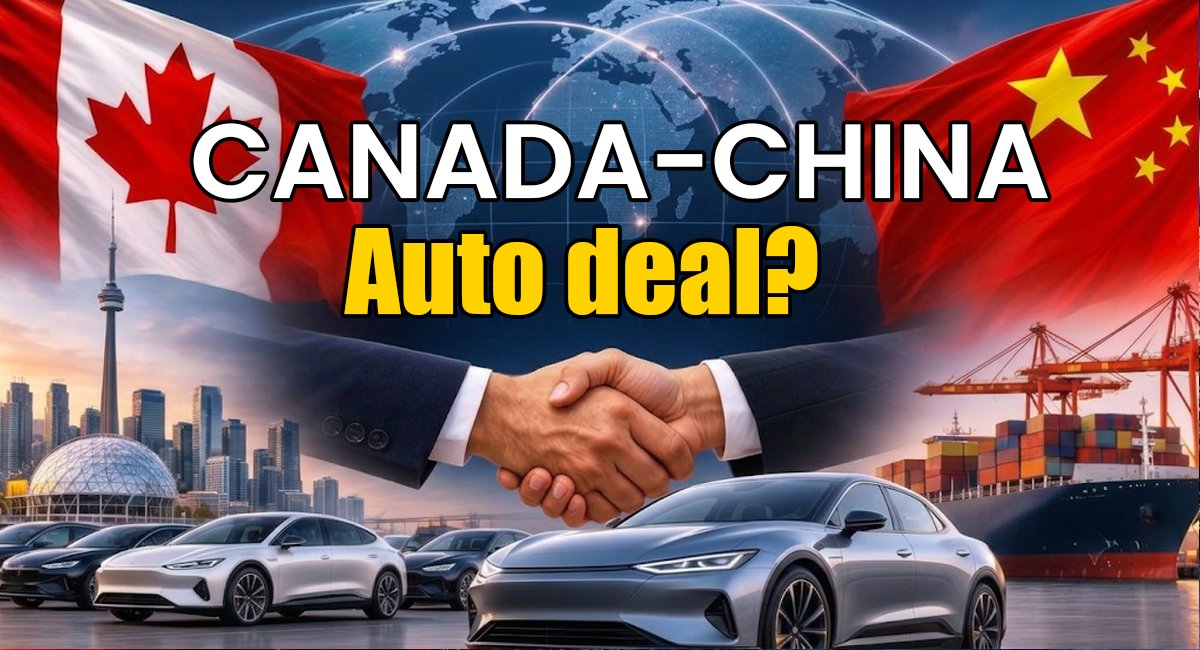
Canada could explore new partnerships with Chinese automakers if trade negotiations with the United States fail to protect its automotive industry, Prime Minister Mark Carney has said.
Speaking to reporters in Phnom Penh, Cambodia, on November
16, Carney said negotiations with US President Donald Trump remain Canada's
priority. However, he indicated that Ottawa could look towards European,
Chinese or Japanese manufacturers if the future of North American auto
production remains uncertain.
The comments come amid continuing trade tensions between
Canada and the United States, particularly over tariffs and the movement of
automotive manufacturing across their shared border. Read the Associated
Press report on Carney's latest remarks for further details.
Why Is Canada Considering Other Auto Industry Partners?
Canada's automotive industry has traditionally been closely
connected to the United States and Mexico. Major manufacturers such as Ford,
General Motors and Stellantis operate facilities across the three countries.
Vehicle production depends on this integrated supply chain,
with components sometimes crossing national borders multiple times before a car
is completed.
However, US trade measures have created uncertainty for
Canadian manufacturers and workers. Carney said the North American automotive
market had become less integrated because of US trade actions.
He wants Canadian auto workers and manufacturing facilities
to continue playing a significant role in the industry. If that becomes
difficult within the North American market, Canada could explore opportunities
with manufacturers from other regions.
Carney described the possibility as a response to changing
trade conditions rather than a negotiating tactic against Washington.
What Did Mark Carney Say About Chinese Automakers?
Carney's remarks came ahead of a planned meeting with
Chinese President Xi Jinping in Shenzhen, where automotive manufacturing is
expected to be among the subjects discussed.
The Canadian prime minister said any potential Chinese
investment would need to involve substantial manufacturing activity inside
Canada. Simply importing vehicle components and assembling them locally would
not meet the conditions he described.
He highlighted the importance of proper labour standards,
manufacturing facilities and domestic supply chains that could expand over
time. Canadian critical minerals should also play a role in electric vehicle
production.
This means Canada is discussing the possibility of
attracting wider industrial investment, rather than simply increasing imports
of Chinese-made cars.
Carney has also made clear that negotiations with the United
States remain his preferred route if they can secure a viable future for
Canadian automotive manufacturing.
Canada-China Electric Vehicle Agreement Explained
Canada and China reached an agreement in January 2026 that
changed the tariff arrangement for Chinese electric vehicles entering the
Canadian market.
Under the agreement, Canada reduced its 100% tariff on
Chinese electric vehicles to 6.1%. The arrangement initially allows up to
49,000 vehicles to enter Canada annually, with the permitted volume expected to
increase over time.
In return, China agreed to reduce tariffs on certain
Canadian agricultural products, including canola.
The Government
of Canada's official announcement explains how the agreement is intended to
encourage Chinese investment, support Canadian manufacturing jobs and
strengthen the country's electric vehicle supply chain.
Readers can also check the government's detailed electric
vehicle import information, which outlines the quota and tariff
arrangements.
However, the agreement has also faced criticism. Ontario
Premier Doug Ford, whose province is central to Canada's automotive
manufacturing industry, warned that allowing more Chinese electric vehicles
into the country could put Canadian jobs and access to the US market at risk.
How Are US Trade Tensions Affecting Canada's Auto
Industry?
The United States remains a major market for Canadian
automotive production. Any disruption to cross-border trade can affect
factories, suppliers, workers and investment decisions on both sides of the
border.
US President Donald Trump has repeatedly pushed automakers
to shift production to the United States. His administration's tariff policies
have added uncertainty for companies operating across North America.
The situation has also affected individual manufacturing
decisions. Canada recently threatened legal action against Stellantis after the
company moved planned Jeep Compass production from Brampton, Ontario, to
Illinois.
The dispute has increased attention on the future of
Canada's automotive facilities and the commitments made by manufacturers that
received public support.
For additional reporting on the wider trade dispute and
Carney's possible shift towards international auto partnerships, read Euronews'
coverage of Canada's position.
What Happens Next?
Carney's comments indicate that Canada is keeping
alternative automotive partnerships open while continuing discussions with
Washington.
His planned meeting with Xi Jinping could provide an
opportunity to discuss Chinese investment and broader trade relations. However,
no new automotive manufacturing agreement has been announced as a result of the
latest remarks.
For Canada, the central issue is how to protect domestic
manufacturing, employment and supply chains while maintaining access to its
largest automotive trading partner.
The direction of future trade negotiations could therefore
shape whether Canada continues to rely primarily on its established North
American production network or expands its partnerships with manufacturers in
Europe and Asia.



Discussion & Comments (0)
No comments yet. Be the first to share your thoughts on this story!
Leave a Comment