

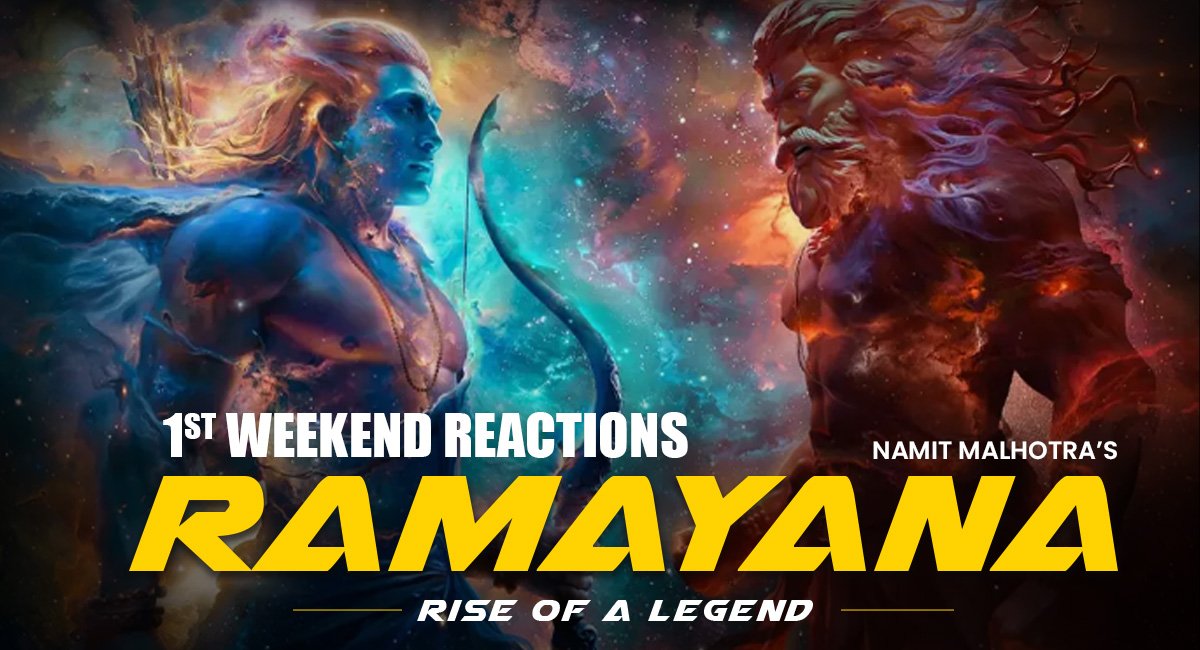
Ranbir Kapoor, Yash and Sai Pallavi's Ramayana: Part 1, also promoted as Ramayana: Rise of a Legend, arrived in theatres worldwide on November 5, 2026. Directed by Nitesh Tiwari, the mythological epic attracted attention for its ambitious production, star cast and music collaboration between Hans Zimmer and A. R. Rahman.
Before its theatrical release, the film had already
generated discussion following its Los
Angeles world premiere reviews. Those early reactions praised its visual
scale and lead performances, while raising questions about its storytelling and
music.
Now that the film has completed its opening weekend,
theatrical reviews offer a more detailed picture. Critics have recognised the
performances of Ranbir Kapoor and Yash, along with the film's production
design. However, its emotional depth, pacing and consistency of visual effects
have also attracted criticism.
What Do First Weekend Reviews Say About Ramayana?
The theatrical response has highlighted one central
contrast: Ramayana looks ambitious on screen, but its storytelling does
not always match the scale of its presentation.
Onmanorama described the film as a visually ambitious
spectacle with strong performances from Ranbir Kapoor and Yash, while pointing
to occasional problems with CGI and emotional resonance.
Hindustan Times also praised the performances and visual
effects, but noted that the first half moves slowly and the music does not
fully meet expectations.
These reviews suggest that the film has several impressive
elements, although its overall impact may depend on how much viewers value
spectacle compared with character development and emotional storytelling.
Ranbir Kapoor as Lord Rama: Restraint Works in His Favour
Ranbir Kapoor's portrayal of Lord Rama is among the film's
most discussed performances.
His approach is largely restrained, with an emphasis on
dignity, composure and controlled emotions rather than exaggerated expressions.
This suits the character's traditional image and gives Ranbir an opportunity to
move away from the intense roles associated with some of his recent films.
Onmanorama appreciated the understated nature of his
performance, while Variety India highlighted the emotional impact he brings to
the story, particularly when Rama's journey towards exile begins.
However, not every review felt that the portrayal
consistently created the devotional connection expected from such an important
character.
Yash as Ravana: A Powerful Screen Presence
Yash makes a strong impression as Ravana, bringing authority
and intensity to one of the epic's most complex characters.
The film also attempts to explore Ravana beyond the
conventional image of a villain. His ambition, devotion to Lord Shiva and
desire for power help establish the character's motivations.
Onmanorama praised Yash's commanding screen presence, while
Variety India highlighted the film's attempt to give Ravana a more layered
personality.
His performance adds weight to the narrative and becomes one
of the film's strongest talking points.
Sai Pallavi as Sita: Why Her Performance Has Divided
Critics
Sai Pallavi plays Goddess Sita, a character whose emotional
journey is central to the Ramayana.
Her portrayal brings gentleness to the role, but some
critics believe that the film does not fully explore the emotional intensity
required in certain important scenes.
Onmanorama specifically discussed the Sita abduction
sequence involving Ravana and Jatayu, suggesting that the moment could have
carried greater emotional impact.
The criticism is not simply about the performance. It also
raises questions about how the screenplay presents Sita's experiences and gives
her character enough emotional space.
Hans Zimmer and A. R. Rahman's Music: Background Score
Gets More Appreciation
The collaboration between Hans Zimmer and A. R. Rahman was
one of the film's most anticipated features.
The background score helps establish the mythological
atmosphere and supports several large-scale sequences. Onmanorama noted that
the music adds grandeur and spiritual quality to the film, even when the
emotional moments do not always land as strongly as expected.
The songs, however, have received a more mixed response.
Hindustan Times also felt that the musical collaboration did not completely
meet the expectations created before release.
The difference is worth noting: the score supports the
film's atmosphere, but the songs have not made an equally strong impression on
every reviewer.
Visual Effects and Storytelling: Where the Film Loses
Some Impact
The production design and visual presentation are among Ramayana's
biggest strengths. The mythical landscapes, elaborate settings and large-scale
sequences help create an expansive cinematic world.
However, the CGI is not equally convincing throughout the
film. Onmanorama pointed out that some computer-generated characters appear
artificial, particularly in parts of the second half.
The storytelling also has its limitations. Some sequences
move quickly, while others could have used more time to develop the emotional
relationships between characters.
This is an important challenge for any adaptation of the
Ramayana. Audiences already know many of its central events, so the film needs
to make those familiar moments emotionally engaging rather than relying only on
their visual scale.
What Works and What Could Have Been Better?
What works well:
- Ranbir
Kapoor's composed portrayal of Lord Rama.
- Yash's
commanding performance as Ravana.
- Large-scale
production design and mythical settings.
- Strong
visual presentation in several major sequences.
- Background
score by Hans Zimmer and A. R. Rahman.
Areas that received criticism:
- Uneven
emotional impact in some important scenes.
- Inconsistent
CGI in certain sequences.
- Songs
that have not fully met audience expectations.
- Slow
or uneven storytelling in parts of the film.
Is Ramayana Worth Watching in Theatres?
Ramayana: Part 1 offers a visually ambitious
cinematic experience supported by strong performances from Ranbir Kapoor and
Yash. Its production design and large-scale sequences make it an interesting
theatrical watch, particularly for viewers who enjoy mythological stories.
However, audiences looking for consistently powerful
emotional storytelling may find some scenes less satisfying. The film's music
also receives a more mixed response than its background score.
As the first instalment of a planned two-part adaptation,
the film leaves room for the next chapter to explore its characters and
emotional conflicts further.
The first weekend has established that the film can impress
through its scale. Its lasting impact, however, will depend on whether the next
instalment can bring the same ambition together with stronger emotional
storytelling.

Discussion & Comments (0)
No comments yet. Be the first to share your thoughts on this story!
Leave a Comment