

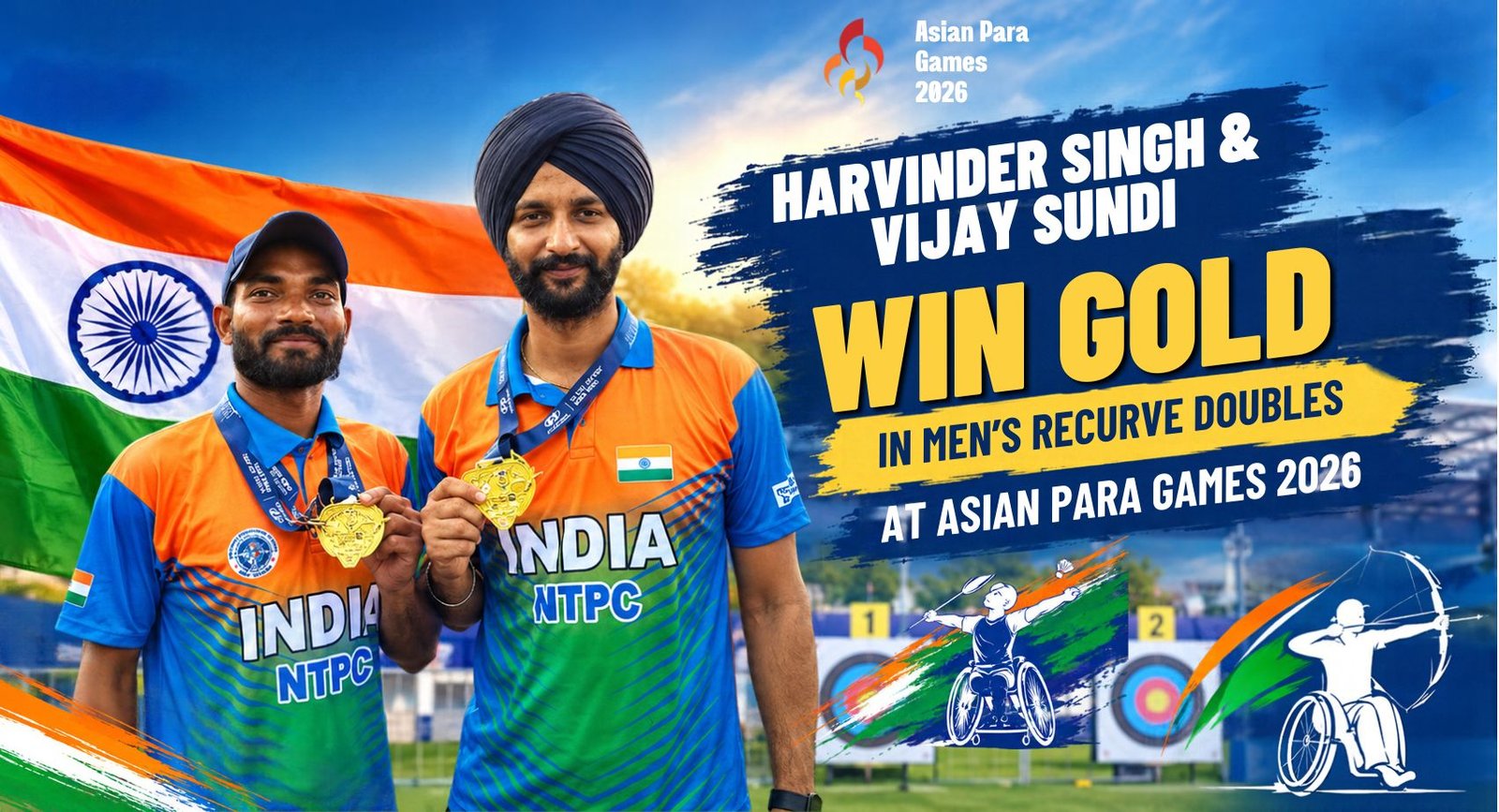
India's para archery team had a proud moment at the Asian Para Games 2026 when Harvinder Singh and Vijay Sundi won gold in the men's recurve doubles event. The Indian pair defeated China 5-1 in the gold medal match and finished at the top of the podium.
The win was another big result for India's para archers.
Archery may look like a quiet sport, but it needs a lot of focus and control.
Athletes have to aim carefully, manage their breathing and release the arrow at
the right moment. Even a small movement can change where the arrow lands.
Harvinder and Vijay stayed focused and did enough to win the final.
India wins the gold medal match
The Indian pair faced a strong Chinese team in the final.
Both sides had worked hard to reach the medal match, so there was a lot at
stake. Harvinder and Vijay kept their focus and won the contest 5-1.
In recurve archery, players use bows that have curved tips.
They aim at a target placed at a set distance and try to score as many points
as possible. In team events, the score depends on the arrows shot by both
members of the pair. This means each archer has to do their part and support
the team result.
Archery needs both physical and mental preparation. Athletes
practise their stance, grip, aim and release again and again so that their
movements become steady. They also have to deal with outdoor conditions,
including wind and changes in light. During a final, staying calm can be just
as important as having good technique.
Harvinder and Vijay managed to handle the challenge and
secured the gold medal for India. The 5-1 score gave the team a strong finish
in the event and added another success to India's para sports campaign.
A little about Harvinder Singh
Harvinder Singh is one of India's leading para archers. He
comes from Ajit Nagar village in Kaithal district, Haryana, and was born on
February 25, 1991. His journey in sport has been an inspiring one because he
continued to work towards his goals despite facing physical challenges.
Harvinder's legs were affected after complications linked to
dengue treatment during his childhood. Even so, he found an interest in archery
and began taking the sport seriously after watching the London 2012 Olympic
Games. He later made his international debut in 2017 and started building a
name for himself in para archery.
His career includes several important achievements. He won a
gold medal at the 2018 Asian Para Games and a bronze medal at the Tokyo 2020
Paralympic Games, which were held in 2021. He reached another major milestone
at the Paris 2024 Paralympic Games by winning gold in men's individual recurve
archery.
These results have made Harvinder an important figure in
Indian para archery. His success shows that a sporting career can grow through
patience and steady work. Winning at the highest level does not happen in one
day. Athletes have to keep practising, learn from difficult moments and prepare
for the next competition.
Vijay Sundi's role in the win
Vijay Sundi joined Harvinder in the men's recurve doubles
event and helped India win the gold medal. While Harvinder has received wider
attention because of his past international results, Vijay's part in the team
victory was also important.
Team archery is different from an individual event because
the final result depends on both athletes. One archer cannot win the match
alone. Each member needs to score well, stay calm and support the other person
throughout the contest. A strong team also needs trust and a clear
understanding of how to approach the match.
Public information about Vijay's personal background and
early career is limited in the available reports. Still, his place in the gold
medal winning pair shows that he was competing at a high level at the Games.
His performance helped India defeat China and secure the top position in the
event.
The victory gives Vijay an important achievement to add to
his sporting journey. It also brings more attention to athletes who may not
always receive the same media coverage as well-known names. Every medal winning
team has players who contribute in different ways, and each contribution
matters.
Why the victory matters
The gold medal is important for Indian para archery because
it shows that the country has strong athletes in team events as well as
individual competitions. Harvinder's experience and Vijay's contribution helped
India finish ahead of China in the final.
Para archery gives athletes with eligible physical
impairments the chance to compete using the same basic aim of the sport: hit
the target as accurately as possible. Athletes train to improve their technique
and learn how to stay steady under pressure. Their performances also help more
people understand para sports and the opportunities available in them.
Wins like this can encourage young people to explore
archery. Better awareness can lead to more participation, improved training
opportunities and greater support for athletes. It is also important for sports
coverage to talk about the athletes' results and effort instead of focusing
only on their disabilities.
India has enjoyed success in para sports across athletics,
badminton, archery and other events. Harvinder and Vijay's gold is another
example of the hard work behind those results. It shows that Indian athletes
can compete strongly against other leading teams in Asia.
A proud moment for Indian archery
Harvinder Singh and Vijay Sundi's 5-1 win over China gave
India the gold medal in men's recurve doubles at the Asian Para Games 2026. The
result was a reward for their preparation, focus and teamwork.
For Harvinder, the win adds another achievement to a career
that already includes medals at major international events. For Vijay, it is a
valuable success on the continental stage. Together, they helped India
celebrate another important result at the Games.
Their victory also sends a simple message to young athletes.
Progress takes time, and success often comes through regular practice and the
willingness to keep going. Harvinder and Vijay showed that focus and teamwork
can make a real difference when the pressure is high.

Discussion & Comments (0)
No comments yet. Be the first to share your thoughts on this story!
Leave a Comment